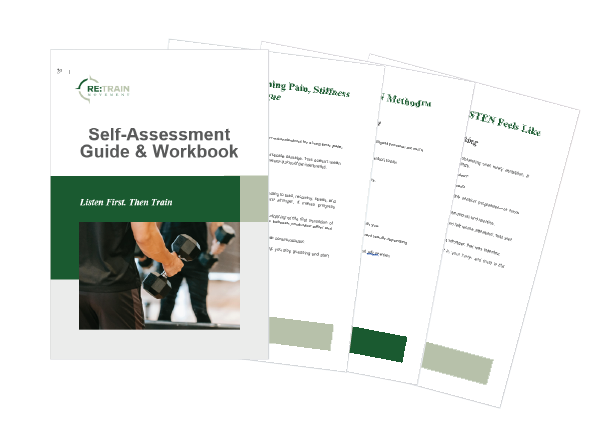
Welcome to the RE:TRAIN Self-Assessment Guide.
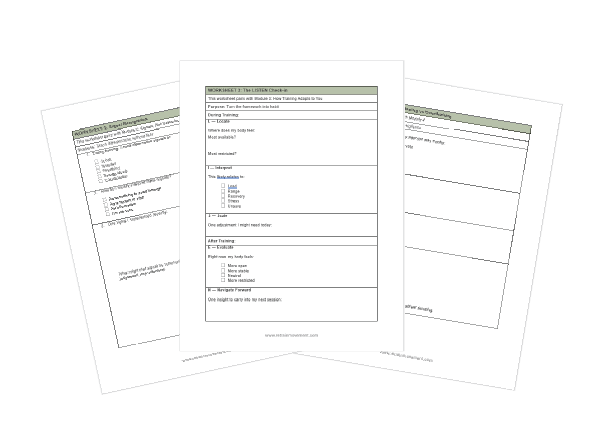
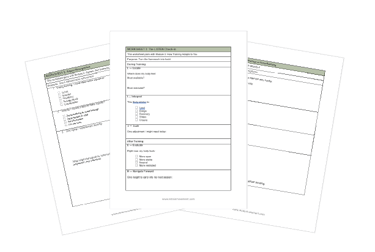
This informational guide aims to support you in determining if the RE:TRAIN program matches your individual goals, requirements, and values. There is also a downloadable workbook with reflective prompts you can download here (link).
Unlike traditional training approaches, RE:TRAIN places a strong emphasis on understanding and working with your body’s unique signals and feedback. Through a series of assessments and reflections, you’ll better understand what sets RE:TRAIN apart and determine if its philosophy aligns with your personal goals.
Engaging with this resource will enable you to evaluate your current relationship with movement, pain, and progress. Our aim is to empower you with information and self-awareness, so you can make an informed decision about joining a program built around sustainable, adaptive, and pain-free training.
This workbook will give you insight into how we train and the questions you will have to ask yourself during and after each session. Use this workbook as a tool to guide your decision and set the foundation for meaningful change.
MODULE 1: Orientation
Why Listening Comes Before Training
Before we talk about exercises, programs, or performance, we need to talk about something more important, the relationship you have with your body.
Most people have been taught to override their body in the name of progress. Push through pain. Ignore stiffness. Treat fatigue as weakness.
The problem isn’t effort; The problem is ignoring feedback.
Your body is constantly communicating through sensation, movement quality, energy, and recovery. When those signals are ignored, progress slows and injuries repeat.
At RE:TRAIN we don’t train despite the body, we train with it.
Listening doesn’t mean backing off forever, it means responding intelligently so training becomes sustainable, adaptive, and pain-free.
This system will teach you how to listen first so every session builds you forward instead of breaking you down.
MODULE 2: Redefining Pain, Stiffness & Fatigue
Signals, Not Setbacks
Let’s reframe three words that have been misunderstood for a long time: pain, stiffness, and fatigue.
• Pain does not necessarily indicate damage
• Stiffness is not failure.
• Fatigue is not weakness.
These are signals.
Signals give insight into how you are responding to load, recovery, stress, and capacity. Ignoring them doesn’t make you stronger, it makes progress unpredictable.
At the same time, listening does not mean stopping at the first sensation of discomfort. It means learning the difference between productive effort and warning signals.
Our goal is not zero sensation. Our goal is clear communication.
When you understand what your body is saying, you stop guessing, and start progressing with confidence.
MODULE 3: The L.I.S.T.E.N. Method™
How Training Adapts to You
Every session at RE:TRAIN follows the same intelligent process; we call it the L.I.S.T.E.N. Method.
Locate where your body is asking for attention today.
Interpret what that signal means.
Scale load, range, or intensity appropriately.
Train with intention and awareness.
Evaluate how your body responds.
Navigate forward using that information.
This is why your program is never rigid. It evolves with you.
Two identical workouts can produce completely different results depending on how the body responds.
Listening allows us to train hard when appropriate, and adjust when necessary, without losing momentum.
MODULE 4: What “Listening” Actually Feels Like
Awareness vs Overthinking
Listening to your body does not mean obsessing over every sensation; It means noticing patterns, not chasing feelings.
• Are movements smooth or guarded?
• Does effort feel controlled or forced?
• Do you feel more capable as the session progresses—or more restricted?
Listening is calm and neutral. Overriding is emotional and reactive.
If you’ve ever pushed through a session and felt worse afterward, that was override.
If you’ve adjusted slightly and finished feeling stronger, that was listening.
The skill you’re building here is trust. Trust in your body, and trust in the process.
MODULE 5: Scaling Without Ego
Why Adjustment Is a Strength
Scaling is one of the most misunderstood concepts in training. Many people believe adjusting load or range means regression, but scaling is how progression becomes sustainable.
Strength isn’t proven by forcing numbers, it’s proven by consistency, control, and recovery. Some days your body is ready for intensity. Other days it’s asking for precision. Both are productive.
The strongest athletes aren’t the ones who never adjust, they’re the ones who know when to adjust.
Scaling is not stepping back. It’s choosing the most effective path forward.
MODULE 6: Post-Session Intelligence
How to Measure Real Progress
Progress isn’t measured by soreness; it’s measured by capacity.
Ask yourself after training:
• Do I feel more open or more restricted?
• More confident or more guarded?
• More stable or more fatigued?
The goal is not exhaustion. The goal is adaptation. If training consistently leaves you feeling depleted, something is off.
Listening after sessions helps us refine, not abandon, the plan. Every session gives us data. We use it.
MODULE 7: Long-Term Strength
Training for the Body You Want to Keep
The goal of training isn’t short-term intensity, it’s long-term capability. Because bodies that last are built through attention, patience, and intelligent stress.
Listening doesn’t make you weaker, it makes you resilient. When you stop fighting your body, it stops resisting you. This is how people train pain-free, not by avoiding challenges, but by respecting adaptation.
Listen first. Then train.
Conclusion
If this Self-Assessment guide resonates with you, the RE:TRAIN system is what you need to start building a sustainable approach to strength and wellness. Our system was designed for those who want to move past quick fixes, and embrace a method that values steady progress, adaptability, and lifelong results.
By integrating what you learn about your body in each session, you’ll develop habits that support your goals and keep you moving forward, free from the cycle of injury and frustration. The RE:TRAIN system is not just a program, it’s a mindset shift toward honoring your body’s signals and investing in your long-term health.
Ready to take the next step? Click below to join, and discover a smarter, sustainable approach to training.
Main Gym
Evolve Strength Royal Oak
#600-8888 Country Hills Blvd NW
Calgary, AB